Jemmy Locksmith Service Team
Local locksmith team
Apr 27, 2026 10 min read

If your Wellesley office has grown from a handful of people to a full team spread across multiple suites, you have probably discovered a familiar problem: too many keys, too much confusion, and a front-desk drawer that looks like a jangle of metal spaghetti. Master key systems solve exactly that — and they are one of the most requested commercial locksmith upgrades we handle for businesses along Washington Street, inside the Wellesley Office Park, and throughout the Route 9 corridor.
A master key system lets you organize access across every door in a building without handing every employee a ring full of individual keys. It sounds elegant in theory, and when it is designed and installed correctly — especially around high-security mortise lock hardware — it truly is. Below we break down how the system works, where mortise lock cylinders fit into the picture, what the upgrade process looks like, and how to decide whether your Wellesley business is ready for one.
## What a Master Key System Actually Is (and Why It Is Not Just a Fancy Door Knob Lock)
A master key system is a planned hierarchy of locks and keys in which different keys open different subsets of doors, while one master key opens every door in the system. At the bottom of the hierarchy sits the individual change key — the key a single employee carries that opens only their office or workstation. Above that sits the sub-master key, which opens a defined group of doors, say, every room in the accounting wing. At the top sits the grand master key, carried by ownership or senior management, which opens everything in the building. Each lock cylinder in the system is machined to precise tolerances so that multiple key cuts can operate it correctly at different levels.
It is important to understand that a master key system is not simply a matter of copying a key so it works in more locks. The cylinders themselves must be pinned to a designed specification, meaning the driver pins and key pins inside each lock are cut to accept more than one key profile. This is called a master wafer or master pin setup. Doing this haphazardly weakens the security of every lock it touches, which is why the design and installation must be handled by an experienced commercial locksmith — and why the quality of the cylinder itself matters so much. A standard door knob lock from a hardware store is generally not built to support a professional master key system. A mortise lock, however, is.
## Why Mortise Lock Hardware Is the Foundation of a Reliable Master Key System
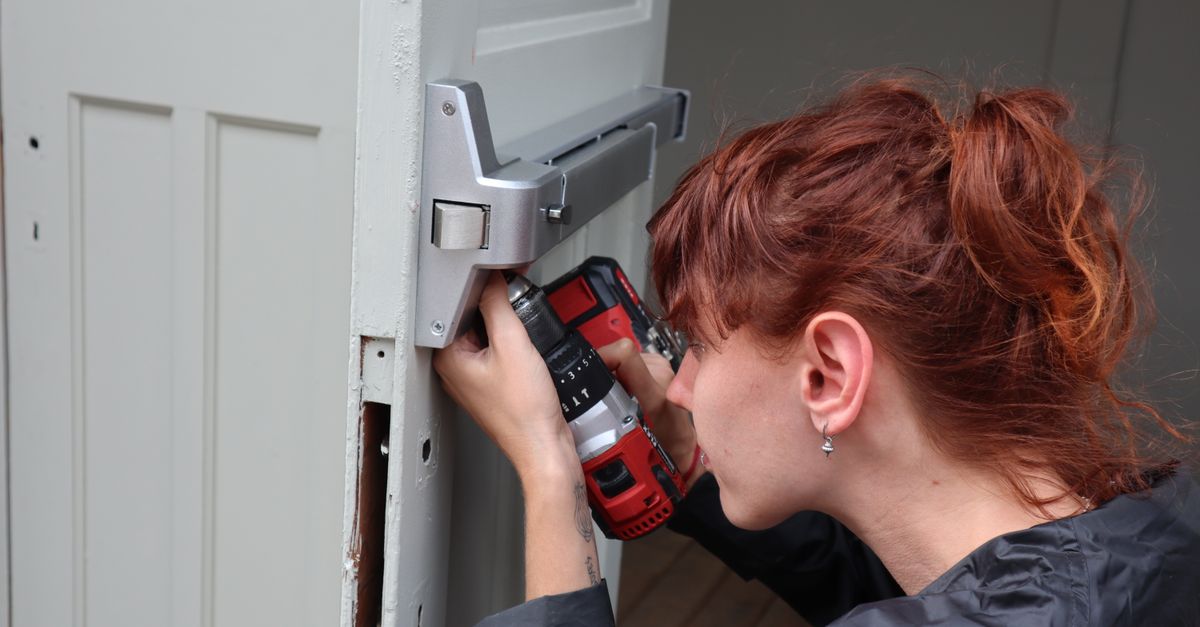
The mortise lock has been the workhorse of commercial door hardware for over a century, and for good reason. Unlike a cylindrical door knob lock that bolts onto the surface of a door, a mortise lock is set into a pocket — the mortise — cut directly into the door edge. The result is a lock body that is physically larger, mechanically stronger, and far more tamper-resistant than most surface-mounted alternatives. It also accepts a wider range of cylinder profiles, which gives a skilled locksmith the flexibility to pin each cylinder precisely to the specifications your master key hierarchy requires. Brands like Schlage and other commercial-grade manufacturers produce mortise lock bodies that are specifically engineered to accept interchangeable cores, making future re-keying or system expansion straightforward rather than a full hardware replacement.
For Wellesley businesses in older buildings — the kind of red-brick professional offices you find near Wellesley Square or along Grove Street — mortise lock hardware is often already present because those buildings were constructed before cylindrical locksets became the consumer standard. In those cases, our team frequently discovers that quality hardware is already in place and only the cylinders need to be re-pinned or replaced to build the master key system the client needs. In newer builds, we may recommend upgrading from existing door knob lock hardware to a mortise lock body first, because the long-term security and re-keying flexibility makes it the right foundation. We will always walk you through the reasoning and confirm a clear, exact price upfront before any work begins.
## How Master and Sub-Master Keying Works, Step by Step
The process starts with a key system design, not a single key cut. Our commercial locksmith team sits down — sometimes literally on-site in your lobby — and maps every door in the building, assigning each one a role in the access hierarchy. Which doors need to be on the grand master? Which group of doors forms a sub-master zone? Do any doors need to sit outside the master system entirely, such as a server room that only one person should ever enter? Once the hierarchy is drawn out, we calculate the key combinations required and select or specify the cylinders. This is why master keying is a design exercise before it is a mechanical one.
Installation involves pinning each cylinder with a combination of standard key pins and master pins to allow the designed key cuts to operate it. After installation, every key in the system is tested against every door it is supposed to open and every door it is not. This verification step is non-negotiable: a pinning error that lets a change key open a door it should not is a security breach, not just an inconvenience. We document the system so that if a key is lost, we can re-key the affected cylinder or cylinders without disturbing the rest of the hierarchy. If you ever need to add a new office wing or a new employee level in the future, the system can almost always be extended rather than rebuilt from scratch. That scalability is one of the primary reasons growing offices make the switch.
## Emergency Locksmith Situations and Commercial Mortise Lock Failures — What to Do
Even a well-designed master key system can produce an emergency. A cylinder can seize in cold weather, a mortise lock body can malfunction if the door is misaligned, or an employee can leave with the only copy of a sub-master key. When that happens at 7 a.m. before a client meeting or at 9 p.m. before a morning inventory, you need an emergency locksmith who understands commercial hardware — not a technician who is only comfortable with residential door knob lock calls. Our team handles commercial mortise lock emergencies throughout Wellesley and the surrounding towns around the clock, 365 days a year.
The right approach to a commercial lockout is never to force or damage the hardware. A skilled technician can use non-destructive entry methods on most mortise lock cylinders to restore access, and will then assess whether the cylinder or lock body needs repair or replacement before re-securing the door. If you find yourself locked out of a commercial space, the best immediate steps are to verify that no other authorized access point is available, confirm you have documented proof of your right to access the space, and call a professional rather than attempting anything that could damage the door or frame. We verify authorization as a standard part of our process — it protects you and us. Call (000) 000-0000 and we will dispatch a technician to your Wellesley location right away.
## Is Your Wellesley Business Ready for a Master Key System? Signs It Is Time to Upgrade
The clearest sign is employee headcount growth. When your team hits roughly eight to twelve people sharing access to different areas, managing individual keys becomes disproportionately time-consuming and the risk of an unaccounted-for key copy rises sharply. Another signal is a recent lease expansion — taking on a second floor or an adjacent suite is the perfect moment to design a unified access hierarchy rather than bolting two disconnected key systems together. Businesses that have experienced a terminated employee situation, where returning every key and verifying no unauthorized copies exist is difficult, are also strong candidates: a master key system combined with re-keying at the cylinder level resolves that risk cleanly without replacing every lock body.
Finally, if your current setup relies entirely on door knob lock hardware throughout the building, a master key upgrade is also the right moment to evaluate whether a mortise lock replacement makes sense for your primary entry and high-traffic internal doors. The conversation about hardware quality is one our commercial locksmith team is happy to have on-site. We serve businesses across Wellesley — from solo practitioners in converted Victorian offices near the train station to multi-department firms in the Wellesley Office Park — and we tailor every master key system design to the specific layout, tenancy, and security goals of that business. No two systems we build are identical, and that is by design. Reach out to us at (000) 000-0000 to schedule a consultation — we are available 24/7.
Frequently asked questions
What is a locksmith call-out fee, and what factors affect the total cost of a master key system?+
A call-out fee is a base charge that covers a technician dispatching to your location — it reflects travel distance, time of day, and the nature of the job before any parts or labor are factored in. For a master key system project, the overall cost depends on the number of doors in the system, the type and grade of cylinder or mortise lock hardware required, whether existing lock bodies can be re-used or need replacement, and any after-hours scheduling. We confirm an exact, all-in price before any work begins so there are no surprises on the invoice.
Are there locks a locksmith cannot open non-destructively?+
In practice, most standard commercial and residential locks — including mortise lock cylinders, cylindrical locksets, and door knob lock hardware — can be opened by an experienced locksmith using non-destructive techniques in the vast majority of legitimate access situations. High-security cylinders with anti-pick and anti-drill features, certain electronic smart locks with failed batteries or damaged circuit boards, and some proprietary restricted-keyway systems may require more specialized methods or, in rare cases, controlled drilling. Our team will always attempt the least invasive approach first, explain the situation clearly before proceeding, and only move to destructive entry when no other option exists.
Can a locksmith just unlock a door without replacing anything?+
Yes — unlocking a door without replacing or re-keying any hardware is a routine service, whether the scenario is a commercial lockout, a mortise lock that has jammed, or a door knob lock that will not turn. An experienced technician can typically restore access non-destructively and then advise whether any underlying mechanical issue needs attention. Ownership or authorized access must be verified before work begins. If the lock is functioning normally after entry, there is nothing that needs to be replaced unless you choose to re-key for security reasons.
Wellesley is known as an affluent, education-rich town — does that affect what kind of security systems businesses here typically need?+
Wellesley is home to Wellesley College, a strong professional services community, and a high concentration of financial, legal, and medical offices — the kind of tenants who handle sensitive client data and valuable assets. That context does drive demand for higher-security commercial hardware, restricted-keyway master key systems, and mortise lock installations over basic cylindrical locksets. It also means that key control — knowing precisely who has access to what, with a documented system that can be updated when staff changes — is a priority rather than an afterthought. Our commercial locksmith work in Wellesley reflects those needs regularly.